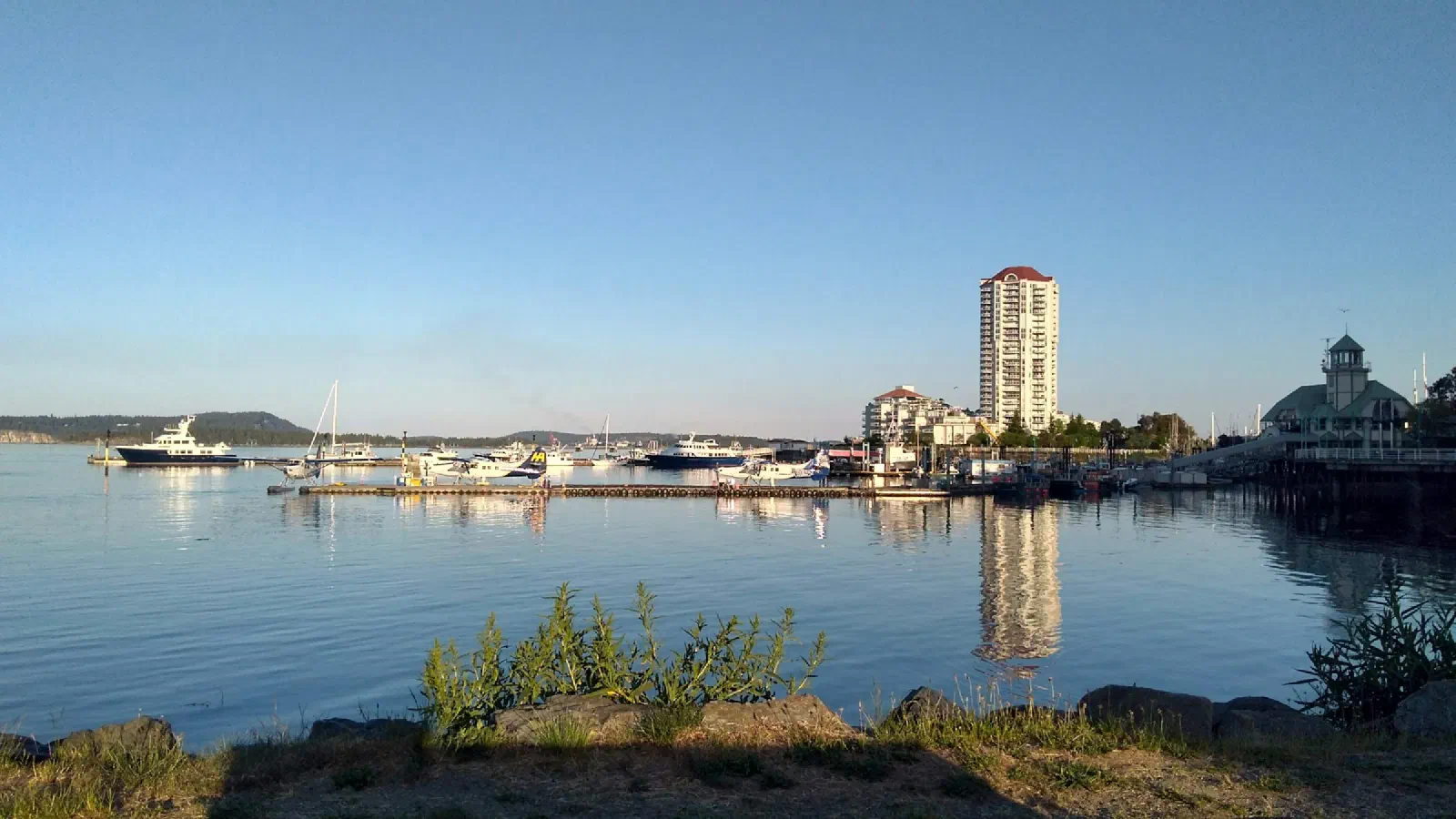
Where to live: the Mid-Island towns compared
The middle of the Island runs along the east coast from the Cowichan Valley north to Qualicum Beach. Every town in this stretch is on the Island Highway, so most newcomers choose by pace and size rather than by distance. Here is how the six main towns compare.
| Town | Population (2021 Census) | Character | Often suits |
|---|---|---|---|
| Nanaimo | 99,863 | The regional city: hospital, university, big-box shopping and both mainland ferry terminals | Working families, people who want services close by, frequent mainland travellers |
| Parksville | 13,642 | Beach town with patio homes, stratas and waterfront condos | Retirees and downsizers, families who want a smaller town |
| Qualicum Beach | 9,303 | Small village centre, treed residential streets, rural Bowser and Deep Bay to the north | Retirees, people who want a quiet village |
| Nanoose Bay | Not a municipality | Waterfront and golf-community homes on the peninsula between Nanaimo and Parksville | People who want a view home and don’t need a town centre at the door |
| Ladysmith | 8,990 | Hillside heritage town above the harbour | People who want a small town between Nanaimo and Victoria |
| Duncan | 5,047 (City of Duncan; North Cowichan next door had 31,990) | Main town of the Cowichan Valley, with farms and acreages around it | Families wanting more land, commuters heading toward Victoria |
Population counts are from the 2021 Census of Canada, as compiled by BC Stats. They count people inside each municipality’s boundaries, not the surrounding rural areas. Nanoose Bay is unincorporated and has no municipal count.
Nanaimo
Nanaimo is the largest city on the Mid-Island and the one most people relocating to Vancouver Island look at first. It has Nanaimo Regional General Hospital, Vancouver Island University and the widest choice of housing, from downtown condos to houses in the north end. Both mainland ferry terminals, Departure Bay and Duke Point, are in the city, which matters if you will travel back to the Lower Mainland often. See movers in Nanaimo for local crews.
Parksville and Qualicum Beach
Parksville and Qualicum Beach together are known as Oceanside. Both are smaller and quieter than Nanaimo, with long beaches and a large retired population. Parksville has more patio homes and strata complexes; Qualicum Beach has a compact village centre and treed residential streets, with rural acreages in Bowser and Deep Bay to the north. Many people moving to Parksville or Qualicum Beach are downsizing from a larger house elsewhere in Canada.
Nanoose Bay
Nanoose Bay sits between Nanaimo and Parksville. It is mostly residential, with waterfront homes, Fairwinds and Schooner Cove. Shopping and services are a short drive away in either direction. Homes here often sit on sloped lots, which is worth mentioning to a mover early.
Ladysmith and Duncan
Ladysmith and Duncan are south of Nanaimo and closer to Victoria. Ladysmith is a hillside heritage town with steep streets above the harbour. Duncan is the main town of the Cowichan Valley, surrounded by North Cowichan, farmland and rural acreages. Both suit people who want a small town but need to reach Nanaimo or Victoria regularly.
Getting your belongings to the Island
Everything you own will cross the water on BC Ferries. There are three main routes between the Lower Mainland and the south half of the Island:
- Horseshoe Bay – Departure Bay (West Vancouver to Nanaimo). Lands in north Nanaimo, the most direct route for Nanaimo, Nanoose Bay, Parksville and Qualicum Beach.
- Tsawwassen – Duke Point (Delta to south Nanaimo). Lands south of downtown Nanaimo, handy for Ladysmith, Cedar and Duncan, and for anyone coming from the south side of Metro Vancouver.
- Tsawwassen – Swartz Bay (Delta to north of Victoria). Mainly for Victoria, but some movers use it for the Cowichan Valley.
The moving-truck ferry leg
How the truck is charged depends on its registered weight. A commercial truck over 5,500 kg registered GVW pays by the foot: the BC Ferries fare index effective April 8, 2026 lists $8.00 per foot on both Nanaimo routes for trucks up to 11 feet wide. A 26-foot truck works out to about $208 each way, plus $21 for each adult passenger, which includes the crew. Smaller trucks under that weight pay the standard vehicle fare of $89 up to 20 feet, plus $8.00 for each extra foot. Fares change, so check BC Ferries or ask your mover for the current figure. The full breakdown is in our guide to moving costs.
Two booking rules matter for a move:
- Horseshoe Bay to Departure Bay must be booked in advance. Since October 15, 2025, every vehicle travelling in that direction, including commercial vehicles, has to book before arriving at the terminal (BC Ferries news release). Drive-up travel is still possible on Tsawwassen – Duke Point.
- Very wide loads are booked by phone. BC Ferries books most commercial vehicles up to 9 feet wide online, but anything wider needs a call to 1-888-223-3779 (BC Ferries commercial travel).
If you are driving your own car over as well, BC Ferries recommends booking ahead for holiday weekends, Thursday and Friday afternoons and evenings, and Sunday afternoons (BC Ferries). Moving day is long enough without a sailing wait.
Hiring a mover: from your old province or on the Island
For a move from another province, most people hire one long-distance mover to load, transport and deliver. The truck crosses on the ferry and the same company unloads at your new home. Long-distance moves are usually priced by weight or volume and distance rather than by the hour. Our long-distance moving page covers how those moves work and how to compare quotes.
An Island-based crew is the better fit when:
- You are shipping a container or driving a rental truck. A local crew can meet the container or truck and unload it into the house, billed by the hour.
- Your things go into storage first. A local crew can move them from storage to the new home once you have the keys.
- You want unpacking or setup help. Local movers can unpack the kitchen, assemble beds and take away the empty boxes.
- Part of the move is already on the Island. If you are moving between Island towns, a local crew is usually the simplest choice.
Timing your move
- Season. Summer is the busiest time for both movers and ferries. A move between October and April is usually easier to book, though winter weather on the mountain passes can slow a truck coming from Alberta.
- Month-end. The last and first days of the month are the busiest for movers everywhere. A mid-month date gives you more choice of crews and sailings.
- Ferry bookings. Ask your mover which sailing they plan to use and whether they have booked it. If they are coming from Horseshoe Bay, the booking is required.
- Your own travel. If you are driving over separately, book your own sailing too, and allow for the truck arriving before or after you.
Storage between possession dates
Out-of-province buyers often find that the sale of the old home and the possession date of the new one don’t line up. There are a few ways to bridge the gap:
- Storage with the long-distance mover. Many long-distance movers offer storage-in-transit, keeping your load in their warehouse and delivering when you are ready. Ask whether it is priced per month and whether redelivery is extra.
- Self-storage on the Island. Your mover delivers to a storage unit near your new home, and a local crew moves it again later. This costs two moves at the Island end but gives you access to your things.
- A container. A portable container can be stored at the company’s yard and delivered when you have possession.
Whichever you choose, keep a box of essentials with you: documents, medications, chargers, bedding and a few days of clothes.
Downsizing before the move
Moving a long distance is priced by weight or volume, so everything you leave behind saves money. It also saves a ferry crossing. Work through the downsizing checklist a few months ahead, and if you are clearing an Island home before a move, the Vancouver Island donation guide lists where to take furniture and household goods.
Your first weeks in BC: a checklist
- Apply for MSP health coverage Apply as soon as you arrive. Coverage starts after a wait period of the rest of the month you become a resident plus two more months. If you are moving from another province, keep your old provincial health plan during that wait (gov.bc.ca: MSP wait period). Adults finish enrolment by getting a photo BC Services Card at an ICBC driver licensing office (gov.bc.ca: apply for MSP).
- Switch your driver’s licence New residents have 90 days to switch a valid out-of-province licence to a BC licence (ICBC: moving to BC). Book an appointment at a driver licensing office and bring proof of your driving experience. After 90 days the old licence is not valid for driving in BC (gov.bc.ca).
- Register and insure your vehicle with ICBC Most vehicles from another province must pass a safety inspection at a BC designated inspection facility first. Qualified private vehicles from Alberta, Saskatchewan or Manitoba may be exempt. Then take the vehicle, its registration and the inspection report to an Autoplan broker, who will register, license and insure it (ICBC: import a vehicle).
- Set up electricity with BC Hydro BC Hydro lets you set up service online at bchydro.com/moving up to 60 days before you move, so the power is on when you arrive (BC Hydro).
- Open a FortisBC account if the home has natural gas Natural gas on the Island is supplied by FortisBC. If the house has a gas furnace, water heater or fireplace, open an account online before move-in (FortisBC).
- Learn your garbage and recycling rules Nanaimo, Nanoose Bay, Parksville and Qualicum Beach are in the Regional District of Nanaimo. Ladysmith and Duncan are in the Cowichan Valley Regional District. Check your municipality or regional district for your collection day and what goes in each cart. The donation guide lists the RDN and CVRD drop-off facilities.
- Update your address with ICBC Once you are settled, ICBC requires you to update your address within 10 days of any move, including later moves within BC (ICBC).